
Developer Warranties for Neighborhood Infrastructure

In Maronda Homes, Inc. of Fla. v. Lakeview Reserve Homeowners Ass’n, Inc. (Fla. 2013), Florida’s Supreme Court issued a significant decision affecting the rights of owners who have purchased a home in a neighborhood with defective infrastructure. The case centered around allegations of defective construction and development of homes in the Lakeview Reserve community, and whether the implied warranties of fitness and merchantability applied to the infrastructure provided by the developer, Maronda Homes.

Background of the Case

The Lakeview Reserve Homeowners Association filed a lawsuit against Maronda Homes and T.D. Thomson, alleging that the infrastructure, drainage systems, retention ponds, and underground pipes in the community were defective and caused flooding and other damages to the homes. The trial court entered a final summary judgment in favor of Maronda Homes and Thomson, but the Fifth District Court of Appeals reversed the decision, holding that the implied warranties of fitness and merchantability applied to the infrastructure and essential services provided by the developer.

Court’s Decision

Maronda Homes appealed the decision to the Supreme Court of Florida, arguing that the Fifth District Court of Appeals erred in its interpretation of the implied warranties of fitness and merchantability, and that the Florida Legislature had preempted the field of construction defects with the passage of section 553.835 of the Florida Statutes. The Supreme Court of Florida held that the implied warranties of fitness and merchantability apply to the improvements that provide essential services to the Lakeview Reserve Homeowners Association, and that section 553.835 does not apply to any causes of action that accrued before the effective date of the statute.

Implications of Decision

The Court’s decision affirms the protection of Florida families against defective development and construction of homes, and ensures that developers are held accountable for the quality of the infrastructure and essential services they provide. The decision also clarifies that section 553.835 of the Florida Statutes does not preempt the field of construction defects. This means that homeowners can still seek damages for defects that occurred before the effective date of the statute, and that developers are still responsible for ensuring that their developments are of a quality that is consistent with industry standards.

Closing

The Maronda Homes case is a significant decision that clarifies the application of the implied warranties of fitness and merchantability to the infrastructure and essential services provided by developers in Florida. The decision affirms the importance of these warranties in protecting homeowners from defective construction and development of homes, and ensures that developers are held accountable for the quality of the infrastructure and essential services they provide. The decision also clarifies that section 553.835 of the Florida Statutes does not preempt the field of construction defects, providing homeowners with legal recourse for defects that occurred before the effective date of the statute

DISCLAIMER: The information provided on this website does not, and is not intended to, constitute legal advice; instead, all information, content, and materials available on this site are for general informational purposes only.


Contractor Licenses in Florida with a Criminal Record

In Florida’s construction industry, obtaining a general contracting or roofing license is a crucial step for professionals looking to establish their businesses. However, for individuals with a criminal history, the path to licensure can be more challenging. While a criminal record may not be an outright bar to obtaining a license, it can significantly complicate the process, requiring careful navigation during application for licensing.

The first thing to understand is that having a criminal history may not automatically disqualify someone from obtaining a general contractor or roofing license in Florida. The state recognizes that individuals can reform and rehabilitate themselves over time. However, the severity of the crime plays an important role in determining the level of difficulty one might encounter during the application process.

Section 489.115(6), Florida Statutes, provides the following guidance:

If the applicant has been convicted of a felony, the board may deny licensure to the applicant based upon the severity of the crime, the relationship of the crime to contracting, or the potential for public harm. The board shall also, in denying or approving licensure, consider the length of time since the commission of the crime and the rehabilitation of the applicant. The board may not deny licensure to an applicant based solely upon a felony conviction or the applicant’s failure to provide proof of restoration of civil rights.

For those with a criminal history, the Construction Industry Licensing Board (CILB) may require them to undergo a board hearing. This hearing serves as an opportunity for the applicant to present their case and demonstrate that they are fit for contracting with the general public. During the hearing, the CILB considers the factors described above.

One of the important considerations is whether the crime in question involved dishonesty or financial misconduct, such as fraud. Crimes that indicate a lack of integrity may raise concerns for the CILB, as the construction industry relies heavily on trust and transparency. Applicants with such convictions may find it necessary to provide compelling evidence of personal growth and reform during the board hearing.

The time elapsed since the conviction is another important factor. Generally, the longer the period without any subsequent criminal activity, the better the chances of obtaining a license. This demonstrates to the CILB that the individual has maintained a clean record and is committed to a law-abiding lifestyle.

Rehabilitative efforts are also closely considered. The CILB may look favorably upon applicants who have actively sought rehabilitation, such as completing counseling, education, or community service. Demonstrating a genuine commitment to personal growth and societal reintegration can significantly enhance an applicant’s case.

Considering the complexities involved, individuals with a criminal history seeking a general contractor or roofing license in Florida may benefit from the assistance of an attorney. As in court, an attorney can help build a strong case for the applicant, gathering evidence of rehabilitation, drafting compelling arguments, and advocating on their behalf during the board hearing.

In summary, while a criminal history may present challenges, it does not necessarily preclude someone from obtaining a general contractor or roofing license in Florida. With careful consideration of the factors involved, individuals with a criminal history may be able to navigate the application process, demonstrating their fitness for licensure, and ultimately obtain a construction license in Florida.

DISCLAIMER: The information provided on this website does not, and is not intended to, constitute legal advice; instead, all information, content, and materials available on this site are for general informational purposes only.
Limits on Non-Compete Agreements in Florida

In Florida’s competitive business world, training your employees on company methods is often critical to success. However, the fear of these employees taking these valuable skills to a competitor is a legitimate concern for many business owners.

To address this challenge, many businesses require their employees to enter non-compete agreements. However, the effectiveness of these agreements is limited by Florida Statute 542.335, which aims to protect free commerce and trade in the state of Florida. In this blog post, we will discuss a few important considerations:

1. Enforceability Conditions:

The statute emphasizes the importance of reasonableness in the terms of non-compete agreements. For small businesses looking to protect their interests, this means ensuring that the restrictions in time, geographic area, and line of business are reasonable.

2. Requirements for Enforcement:

Small businesses must be meticulous in documenting non-compete agreements. These contracts should be in writing and signed by the sales representatives against whom enforcement might be sought.

3. Legitimate Business Interests:

To be enforceable, a non-compete agreement must have a legitimate business interest. This could include protecting trade secrets, confidential business information, customer relationships, goodwill, or investments in specialized training.

4. Necessity of Restraint:

Small businesses should establish that the specified restraint is reasonably necessary to safeguard their legitimate business interests. However, if challenged, the burden is on the opposing party to prove that the restraint is overbroad, overlong, or not reasonably necessary.

5. Presumptions for Time Limitations:

The statute provides specific time presumptions based on the nature of the restrictive covenant. Small businesses need to align their non-compete agreements with these guidelines to increase the likelihood of enforceability. In most situations, a court will presume restrictions that are 6 months or less to be reasonable, and will presume restrictions lasting longer than two years to be unreasonable.

6. Considerations for Enforcement:

When enforcing non-compete agreements, small businesses should be aware that the court will not consider individualized economic hardships faced by the employee. However, the court may consider the impact of enforcement on public health, safety, and welfare.

7. Enforcement and Remedies:

In the event of a breach, small businesses can seek remedies such as temporary and permanent injunctions, ordering the employee to cease violations of the agreement. Additionally, violation of a valid non-compete agreement creates a presumption of irreparable injury to the business.

8. Attorney’s Fees and Costs:

While not always included in small business contracts, the statute allows for the potential award of attorney’s fees and costs to the prevailing party in actions related to the enforcement or challenge of non-compete agreements. This can be both a blessing and a curse, depending on who wins in the court case.

Closing

While non-compete agreements can be lawful in Florida, business owners should be aware of the limitations imposed by Florida Statute 542.335. By understanding the enforceability conditions, requirements, and limitations outlined in the statute, small businesses will have the best chance of having the agreements enforced.

DISCLAIMER: The information provided on this website does not, and is not intended to, constitute legal advice; instead, all information, content, and materials available on this site are for general informational purposes only.

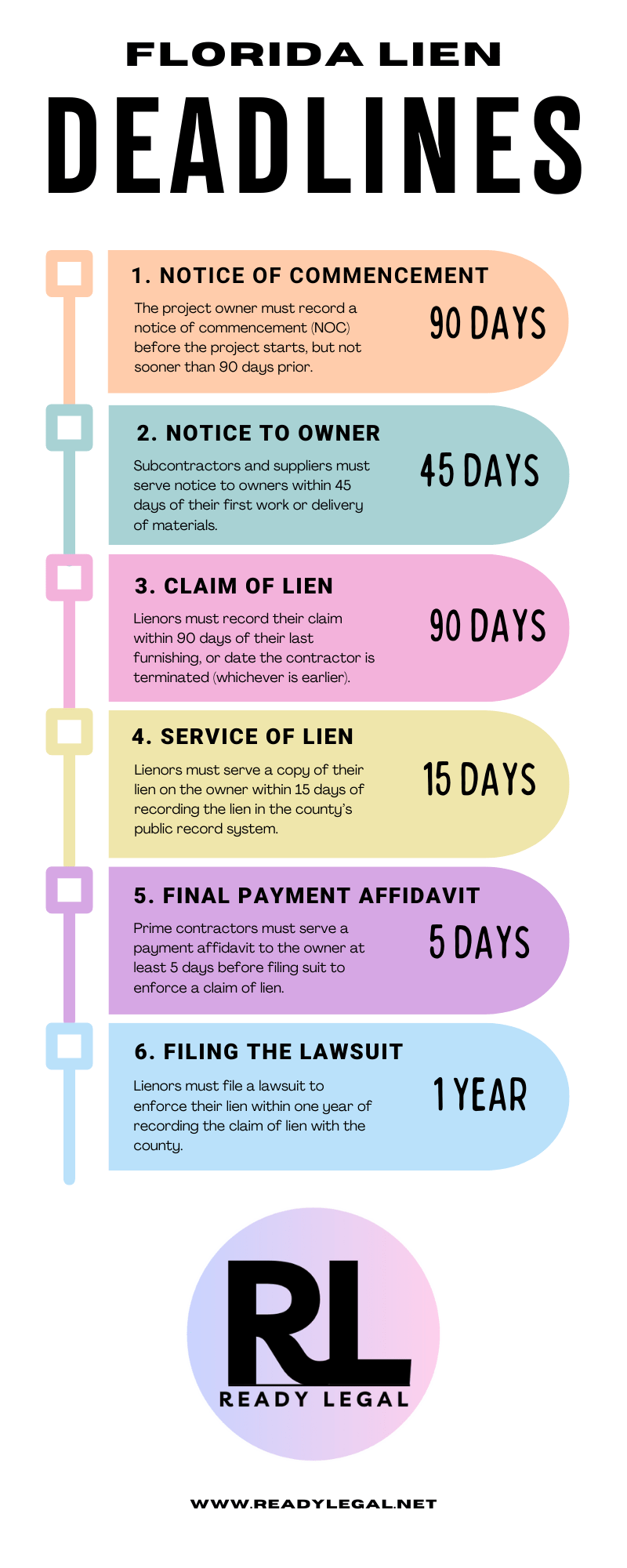
6 Critical Lien Deadlines in Florida Construction

Florida’s construction industry is governed by a comprehensive set of laws. Chapter 713 plays a crucial role in outlining the procedures and deadlines related to construction liens. Understanding these deadlines is essential for all parties involved in a construction project to ensure timely payment. In this blog post, we’ll delve into six important deadlines under Florida’s Construction Lien Law:

  1. Notice of Commencement (90 days):

Before embarking on a construction project, it is imperative for property owners and contractors to be aware of the first deadline – the recording of a Notice of Commencement. This notice must be recorded before the project starts, but not sooner than 90 days prior. Failing to adhere to this deadline may result in complications later in the project. The Notice of Commencement serves as a formal declaration, providing crucial information about the project, such as the property description, owner’s information, and the general contractor.

  1. Notice to Owner (45 days):

Once work begins on the project, parties who are not in a direct contract with the owner have up to 45 days from the commencement of their work or delivery of materials to serve a Notice to Owner. This notice is a proactive step that helps secure the lienor’s rights by formally informing the property owner about their involvement in the project. Missing this deadline can limit a contractor’s ability to file a valid lien later on, underscoring the importance of timely serving an NTO.

  1. Claim of Lien (90 days):

The third critical deadline involves the recording of a Claim of Lien. This must be done within 90 days from the earlier of: (a) the claimant’s last date of work, or (b) termination of the contractor under whom the lienor is working. The Claim of Lien is a legal document that outlines the amount owed for services or materials provided. It serves as a formal claim against the property and should be recorded within the specified timeframe to maintain its validity.

  1. Service of Claim of Lien (15 days):

Recording a Claim of Lien is not the final step; serving a copy of the claim on the property owner is equally important. Lienors are required to serve a copy of the Claim of Lien on the owner within 15 days of recording the lien. This step ensures transparency and provides the property owner with notice of the outstanding debt. Failure to meet this deadline can impact the lienor’s ability to enforce the lien effectively.

  1. Contractor’s Final Payment Affidavit (5 days):

As the project nears completion, the direct contractor must be mindful of the deadline to provide the owner with a Contractor’s Final Payment Affidavit. This document, which attests to all payments made to subcontractors and suppliers, must also be given to the owner at least 5 days before filing a suit to enforce a lien. Timely issuing a CFPA ensures that the owner cannot move to dismiss the lawsuit for the contractor’s failure to comply with the statute.

  1. Deadline to File Suit to Enforce the Lien:

The final and perhaps most critical deadline is the requirement to file a suit to enforce the lien within one year of recording the lien. Missing this deadline can result in the loss of the lienor’s right to pursue legal action to foreclose on the lien. Contractors and subcontractors must be vigilant in tracking this timeframe to protect their interests effectively.

Closing:

Navigating the intricacies of Florida’s Construction Lien Law is essential for all stakeholders involved in construction projects. By understanding and adhering to these six crucial deadlines, property owners, contractors, and subcontractors can mitigate risks, maintain transparency, and ensure a fair resolution of payment disputes.

Click HERE to download or share a copy of our graphic.

DISCLAIMER: The information provided on this website does not, and is not intended to, constitute legal advice; instead, all information, content, and materials available on this site are for general informational purposes only.

Addressing Title Issues as a Florida Homeowner

Buying a home is a significant milestone, often accompanied by a myriad of paperwork and legalities. Amidst the pile of documents, one that stands out but is often overlooked is the title insurance policy. Title insurance is a crucial aspect of real estate transactions, offering protection against potential issues that may arise with the property’s title. However, there are times when unforeseen problems do emerge, leading homeowners to initiate a title insurance claim.

Understanding Title Insurance

Before delving into the claims process, let’s grasp the concept of title insurance. Unlike traditional insurance policies that protect against future events, title insurance focuses on the past. It safeguards homeowners and lenders against any hidden defects in the property’s title that may surface after the purchase.

A title insurance claim is a formal request made to the title insurance company, seeking financial assistance to rectify issues with the property’s title. Common reasons for filing a claim include wild deeds, boundary disputes, undisclosed heirs, and forgery, among others.

Identifying Your Title Insurer

The first step in initiating a title insurance claim is identifying who your title insurer is. This information can typically be found in your title insurance commitment, a document provided during the closing of your home purchase. If you no longer have this document, reaching out to the title company that facilitated the closing can help you determine the insurer.

Common Reasons for Title Insurance Claims

Title insurance claims can arise from a variety of issues, each posing a potential threat to your property rights. Wild deeds, for instance, refer to unauthorized or forged deeds that may cloud the title’s legitimacy. Boundary disputes often occur when the property lines are unclear or disputed by neighboring landowners. Other common issues include outstanding liens, encroachments, and errors in public records.

Options for Handling a Title Insurance Claim

Once you’ve identified your title insurer, the next step is deciding how to proceed with the claim. Two primary options exist – hiring an attorney or drafting the claim yourself.

Seeking legal assistance is often the preferred route, especially when dealing with complex title issues. An attorney with expertise in real estate law can navigate the intricacies of the claims process, ensuring that all legal requirements are met. While this approach provides a level of assurance, it comes with associated legal fees, potentially adding to the overall cost of resolving the title issue.

For those comfortable navigating legal processes, drafting the title insurance claim independently is an option. This approach can save on legal fees but requires a thorough understanding of the title insurance policy and the specific claim requirements. It’s crucial to follow the notice provisions outlined in the policy meticulously to avoid any potential setbacks.

Initiating the Title Insurance Claim

Regardless of the chosen approach, instituting a title insurance claim involves putting the title insurance company on notice. This is typically done by sending a formal written notice outlining the issue, the basis for the claim, and the requested resolution. Adhering to the notice provisions specified in the title insurance policy is crucial for a successful claim.

Conclusion

Initiating a title insurance claim is a process that demands attention to detail and a thorough understanding of the intricacies involved. Whether you choose to enlist the help of a legal professional or embark on drafting the claim independently, ensuring compliance with the title insurance policy’s notice provisions is paramount. As a homeowner, being proactive in addressing title issues with the support of your title insurance can safeguard your property rights and provide peace of mind in your homeownership journey.

DISCLAIMER: The information provided on this website does not, and is not intended to, constitute legal advice; instead, all information, content, and materials available on this site are for general informational purposes only.