
Can You Still Get Paid Without a Lien?

When a contractor faces the frustration of unpaid funds and realizes they’ve missed the window for filing a lien, not all hope is lost. While the ability to foreclose on a lien may be forfeited, Florida contractors still have options to pursue unpaid debts through other legal avenues.

One such recourse is suing the customer for breach of contract. However, this avenue comes with its own set of challenges.

Attorneys’ Fees and “The American Rule

Unlike a lien, where attorneys’ fees are often recoverable, pursuing a breach of contract claim under the American Rule may not guarantee the recovery of legal costs. If the contract does not explicitly stipulate the entitlement to attorneys’ fees, the contractor may not be able to recover their legal expenses, even if successful in court. This creates a significant barrier for smaller debts, where the attorneys’ fees can be more expensive than what is owed.

Judgment Challenges: Residential Property and Homestead Protection

While winning a judgment may seem like a victory, its enforceability could be hindered, especially when dealing with residential properties protected by homestead laws. This issue arises when the customer does not have the funds to pay your judgment. Ordinarily, in this scenario, you could pursue the judgment by foreclosing against the customer’s real property. However, if the property is homestead property, this is probably not an option.

Despite homestead challenges, a judgment lien can serve as a cloud on the title, affecting the customer’s ability to sell their property. While this may prompt payment when the property is eventually sold, it offers no immediate relief to the contractor. The timeline for repayment remains uncertain and could extend over a considerable period.

Garnishment and Execution

Another option available to contractors is garnishing wages or executing on the customer’s assets. However, this route may be too costly for pursuing smaller balances, and success depends on the availability of funds or assets. In cases where the customer lacks sufficient resources, these efforts may prove financially unworkable for the contractor.

Closing

When the traditional route of filing a lien is closed off, contractors in Florida must carefully weigh their options. Suing for breach of contract is a plausible alternative, but it comes with its share of limitations, from the recovery of attorneys’ fees to challenges in enforcing judgments against the customer.

DISCLAIMER: The information provided on this website does not, and is not intended to, constitute legal advice; instead, all information, content, and materials available on this site are for general informational purposes only.


The 5 Powers of The Florida Construction Lien

In the state of Florida, contractors wield a powerful tool that significantly enhances their chances of receiving payment—the construction lien. This legal instrument serves as both a sword and a shield for contractors, providing a robust mechanism to secure payment from a customer who is delinquent on their bill. In this blog post, we will discuss five key reasons why construction liens are such an effective tool for getting paid:

1. The Lien Strikes Fear with the Risk of Foreclosure

Perhaps the most potent aspect of a construction lien is its ability to strike fear into the owner of the property. By filing a lien against a property, a contractor effectively opens the door to the possibility of foreclosure. The mere mention of foreclosure can be a powerful motivator for property owners to settle outstanding debts, as the potential loss of their property looms large. This fear factor often compels owners to prioritize resolving payment disputes promptly to avoid the serious consequences associated with foreclosure.

2. Lien as a Potential Violation of the Owner’s Mortgage

Filing a construction lien introduces an additional layer of risk for property owners, as it may potentially violate the terms of their mortgage note. Many mortgage agreements include clauses that prohibit the property owner from encumbering the property with liens without the lender’s consent. Violating these terms could trigger a default under the mortgage, putting the owner in a precarious financial situation. This added pressure incentivizes owners to address payment issues swiftly to avoid triggering mortgage defaults.

3. Clouding the Title: A Barrier to Selling the Property

A construction lien has the power to cloud the title of the property, creating a significant obstacle for property owners attempting to sell. Prospective buyers are often hesitant to purchase a property with a clouded title, as it poses potential legal complications and uncertainties. The cloud on the title effectively puts the ball in the property owner’s court, compelling them to resolve the payment dispute and clear the title before proceeding with any sale.

4. Potential Recovery of Attorneys’ Fees

In Florida, the construction lien statute allows the prevailing party to recover their attorneys’ fees in litigation, which can add up significantly. This provision adds an extra layer of risk for the delinquent party, as they may be responsible not only for the overdue payment but also for the legal costs incurred by the contractor in the pursuit of their compensation. The prospect of facing a legal battle with the potential for substantial attorneys’ fees often pushes parties to seek an amicable resolution.

5. Foreclosure as a Last Resort

The ultimate power of a construction lien lies in its potential for foreclosure. If all else fails and the payment dispute remains unresolved, the contractor can take legal action to foreclose on the property. This means that even if the property owner is otherwise insolvent or uncooperative, the contractor has a pathway to recover their payment through the sale of the property at auction.

In sum, the construction lien serves as a multifaceted tool for contractors in Florida, offering a combination of legal leverage and financial consequences to secure timely payment for their services. By understanding and strategically employing the power of construction liens, contractors can navigate payment disputes with confidence, knowing they have a robust mechanism in place to protect their interests.

DISCLAIMER: The information provided on this website does not, and is not intended to, constitute legal advice; instead, all information, content, and materials available on this site are for general informational purposes only.
How to File a Construction Lien in Florida

Florida law provides contractors, suppliers, and other parties with the right to claim a lien against real property for work and supplies provided for improvements. Liens are a powerful tool for seeking payment, but can be complicated to use.

In Florida, liens are recorded in the county clerk’s office for the county where the project is located. Liens can be recorded in person at the local county clerk’s office. Additionally, many Florida counties have adopted electronic recording methods, such as Simplifile.

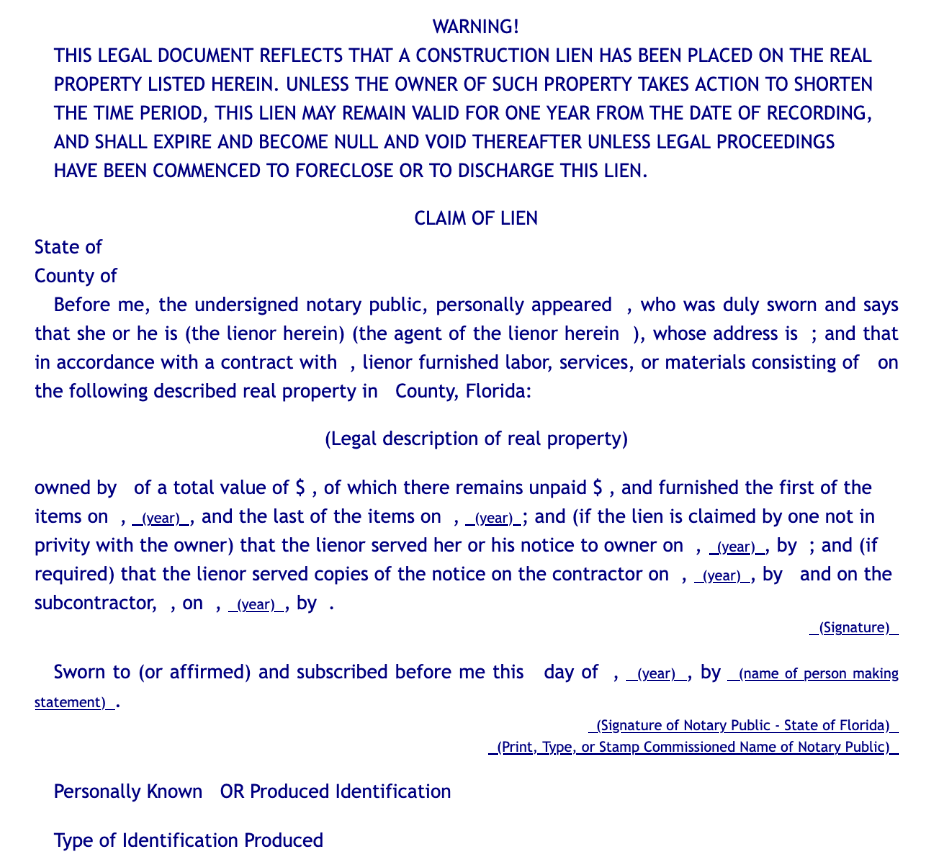
Florida law prescribes the form and substance that a claim of lien must adhere to. All lien claims in Florida must be in substantially the following form:

Florida’s mandatory form for a construction claim of lien

While seemingly simple, errors in the claim of lien can result in significant consequences, such as loss of the contractors lien rights. Therefore, it is advisable to seek the assistance of an attorney when preparing a claim of lien.

Warning: If you are claiming a lien on behalf of a business, you cannot prepare the lien yourself unless you are a licensed attorney. Doing so is considered unlicensed practice of law, which is a felony in the state of Florida.

After recording a claim of lien with the county clerk’s office, the contractor must serve a copy to the owner within 15 days of doing so. Failure to serve a claim of lien within 15 days after recording will render the claim of lien voidable to the extent that the failure or delay is shown to have been prejudicial to any person entitled to rely on the service.

Recording a Construction Lien in Orange County, Florida

If you are recording a construction lien in Orange County, FL, the county has established several vendors who can handle your e-recording needs. The Orange County Comptroller’s Official Records Department also records documents in person at the following address:

109 E. Church St. Suite 300
Orlando, FL 32801
407-836-511

DISCLAIMER: The information provided on this website does not, and is not intended to, constitute legal advice; instead, all information, content, and materials available on this site are for general informational purposes only.

Mandatory Documents for Your Florida Roofing License Application

Securing your certified roofing license in Florida involves not only mastering your craft but also navigating a comprehensive application process. Understanding the required fees and essential documents is paramount to a successful application. The following list represents the DBPR’s mandatory requirements that you must submit with your application to the CILB:

1. Application Fees: The Florida Department of Business and Professional Regulation has outlined specific fees based on the time of application. Applying between May 1st of an EVEN year through August 31st of an ODD year incurs a fee of $245. On the other hand, applying between September 1st of an ODD year through April 30th of an EVEN year carries a reduced fee of $145. Ensure your check is payable to the Florida Department of Business and Professional Regulation.

2. Credit Report Requirements: To provide a comprehensive view of your financial responsibility, a credit report is a mandatory component of your application. Obtain a credit report containing your FICO-derived credit score from a nationally recognized credit reporting agency. The report should include a public records statement indicating that your records have been checked at local, state, and federal levels.

  • If your credit score falls below 660 (FICO derived), you must also submit proof of completion of a 14-hour financial responsibility course approved by the Board. A list of approved courses can be found on the official website.
  • Additionally, a credit report on the business you represent is required. This report should also come from a nationally recognized credit reporting agency and include a public records statement indicating checks at local, state, and federal levels.

3. Electronic Fingerprints: As part of the application process, electronic fingerprints are mandatory. This step contributes to ensuring a secure and accurate evaluation of your application. Electronic Fingerprinting is located at various convenient sites throughout the state.

4. Supporting Legal Documentation: Prepare any supporting legal documentation deemed necessary for your application. Be thorough in gathering and presenting these documents to avoid delays in the processing of your application.

5. Proof of Satisfaction of Liens, Judgments, and Discharge of Bankruptcy: If applicable, include documentation proving the satisfaction of liens, judgments, and discharge of bankruptcy. This step reinforces your financial responsibility and compliance with legal obligations.

Navigating the complexities of the Florida certified roofing license application requires attention to detail and adherence to specific guidelines. The journey may involve paperwork and financial commitments, but each document and fee bring you closer to realizing your goal of becoming a certified roofing professional in Florida.

DISCLAIMER: The information provided on this website does not, and is not intended to, constitute legal advice; instead, all information, content, and materials available on this site are for general informational purposes only.

Key Objectives for Business Legal Consultations

Meeting with your business’s attorney is an important, and often expensive necessity in operating your business. With that in mind, it is helpful to approach these meetings with a strategy to obtain legal advice in the most effective and efficient manner possible. Whether you find yourself entangled in a contract dispute or contemplating a significant business decision, this article outlines three key goals for meeting with your attorney.

Goal 1: Determine Your Business’s Rights and Obligations

The first objective in meeting with your business attorney is to ascertain your rights concerning the subject matter at hand. For instance, if you are considering terminating a contract, understanding your rights to do so is important. Your attorney can analyze the contract, providing insights into the termination provisions and any conditions that might trigger your right to exit the agreement.

By delving into the nuances of the contract, your attorney helps you decipher and identify any grounds for exiting it. This allows you to make informed decisions aligned with your business’s rights, minimizing the risk of unintended consequences.

Goal 2: Determine the Consequences of Your Legal Course of Action

Knowing your rights is essential, but equally critical is understanding the potential repercussions of exercising those rights. In our example of contract termination, your attorney will outline the consequences your business might face if you terminate the contract without the appropriate grounds. This involves assessing any financial liabilities, penalties, or legal actions the other party could pursue.

This knowledge allows you to weigh the benefits against the risks, preventing impulsive decisions that could have severe financial or legal consequences. Armed with a understanding of potential pitfalls, you can make strategic choices that align with your business’s long-term interests.

Goal 3: Determine the Recommended Course of Action

With a clear understanding of your rights and the consequences tied to them, the next crucial objective is to determine the recommended course of action. Your attorney, drawing on their legal expertise and experience, can provide valuable insights into the optimal strategy based on the unique circumstances of your case.

For instance, even if the contract is enforceable and carries strict penalties, your attorney might advise you that the risk of the other party successfully enforcing those penalties is minimal. This risk-benefit analysis helps tailor the legal advice to your specific situation, ensuring that the chosen course of action is optimized for the best outcome.

Closing

In essence, a consultation with your business attorney revolves around three key objectives: understanding your rights, grasping the consequences of exercising those rights, and determining the recommended course of action. By pursuing these objectives, you empower your business to make informed, strategic decisions in the face of legal challenges.

DISCLAIMER: The information provided on this website does not, and is not intended to, constitute legal advice; instead, all information, content, and materials available on this site are for general informational purposes only.