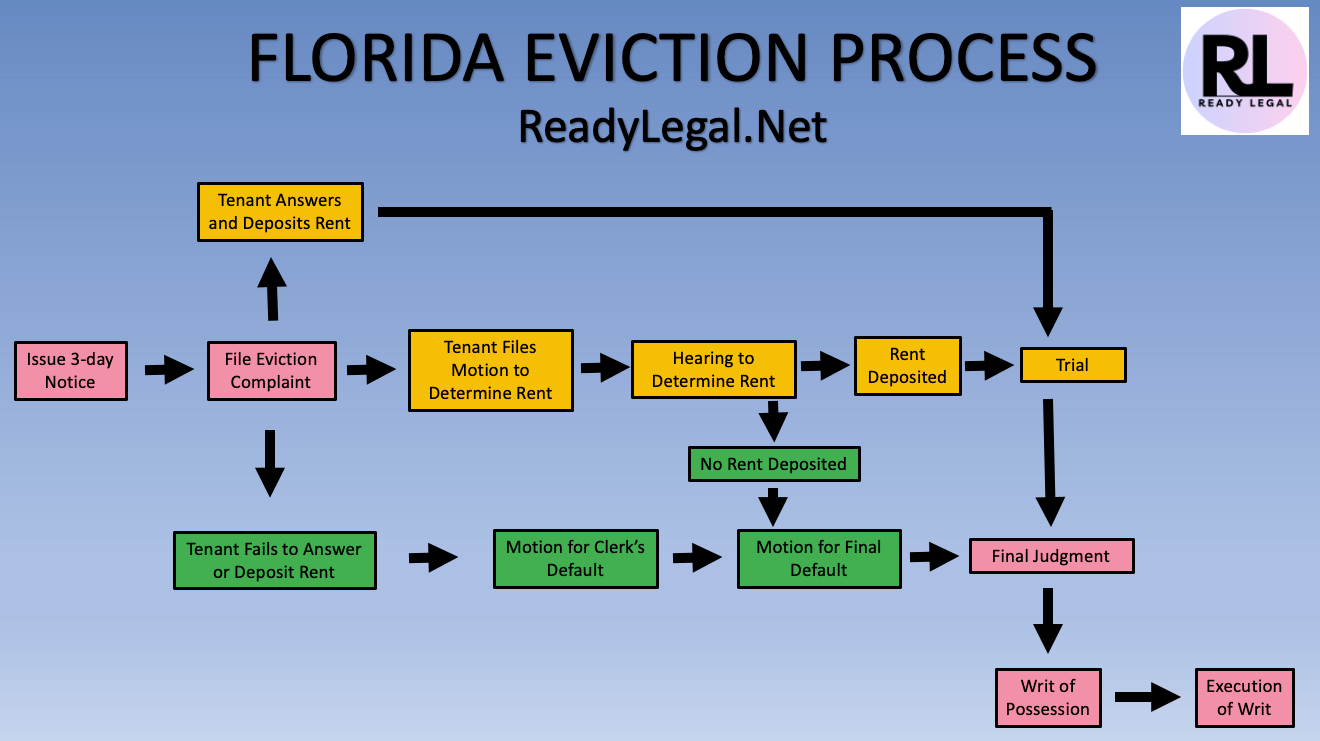
Filing an eviction in Florida can be a difficult and time consuming process that no landlord likes to deal with. However, some evictions are more difficult and take more time than others. Evictions can generally follow one of three routes depending on how the tenant responds to the complaint. In this blog post, we’ll discuss the three main routes that a Florida eviction can follow.
Start of Proceedings
In all cases involving non-payment of rent, the landlord is required to issue a three-day notice, informing the tenant that they have three days to either pay rent, or surrender possession of the property. If the tenant fails to comply with this notice, the landlord must then file a complaint in court for eviction. The complaint and summons must then be served on the tenant at the property.
Route 1: Uncontested Eviction
If the tenant fails to respond to the complaint or deposit rent (absent a motion to determine rent) within five business days, the eviction is essentially uncontested. In this scenario, the landlord’s first step is to file a motion for clerk’s default and affidavits regarding the tenant’s non-military status. If filed properly, the clerk will enter a “clerk’s default” against the tenant.
The clerk’s default is the first step in obtaining a final default judgment. After the clerk enters a default, the landlord must apply with court, via motion for final default judgment, requesting the court enter final judgment. If done correctly, the court will enter a final default judgment, and direct the clerk to issue a writ of possession to the sheriff’s office.
Route 2: Contested Eviction
If the tenant files an answer to the complaint and deposits the rent in dispute in the court’s registry, the tenant has essentially contested the eviction, and the case must proceed to trial. At trial, the landlord will be required to present a case showing that the tenant failed to properly pay rent, in breach of the lease, and that these grounds warrant termination of the lease and eviction.
If the landlord is successful, the court will enter final judgment following trial, and direct the clerk to issue a writ of possession. Additionally, the court may order the delinquent rent held in the court’s registry to be disbursed to the landlord on a complaint for money damages.
Route 3: Dispute as to Rent
Under Florida law, tenants may also respond to the lawsuit by filing a motion to determine rent. In this scenario, the tenant effectively asks the court to decide how much rent is purportedly owed and must be deposited in the court registry for the case to proceed to trial.
If the tenant files a motion to determine rent, the court will hold an evidentiary hearing to determine the rent the tenant must deposit. After the hearing, the court will order the tenant to deposit rent. Additionally, if the tenant has not responded to the complaint, the court may direct the tenant to file an answer to the complaint. If the tenant complies with this order, the case will proceed to trial, where the landlord can obtain a final judgment and writ of possession.
Final Process
In each scenario, the landlord must obtain a final judgment and writ of possession. However, this is not the end of the road. The landlord must next present the writ to the county sheriff’s office, along with a fee, for the sheriff to execute on the writ of possession. During execution, the sheriff will provide the tenant with 24 hours notice to vacate the property, and then return the next day to physically remove the tenant, if necessary. The landlord is typically required to meet the sheriff and may change the locks at this time.
DISCLAIMER: The information provided on this website does not, and is not intended to, constitute legal advice; instead, all information, content, and materials available on this site are for general informational purposes only.
 READY LEGAL